

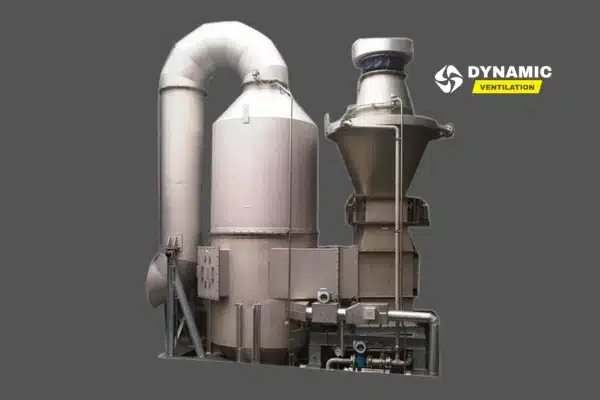
Choosing The Right Venturi Scrubber For Your Factory Needs
Factories face constant challenges from airborne pollutants, dust, and harmful gases that impact worker health, equipment performance, and regulatory compliance. A venturi scrubber stands out as a proven solution for capturing these contaminants through high-velocity liquid-gas contact. Selecting the appropriate venturi scrubber requires understanding your specific factory conditions and operational goals. This guide walks through key factors, helping you make informed decisions for cleaner, safer industrial air.
Understanding Venturi Scrubber Fundamentals
Venturi scrubbers work by accelerating contaminated gas through a constricted throat where water or chemical solutions create intense turbulence. This collision captures fine particles, soluble gases, and aerosols effectively. Unlike baghouses or electrostatic precipitators, venturi scrubbers excel with sticky, wet, or combustible dusts that clog other systems.
The design’s simplicity throat, venturi section, and mist eliminator ensure reliable performance across harsh conditions. Proper selection matches throat velocity to particle size distribution and gas volume, preventing underperformance or excessive pressure drops.
Assessing Your Factory’s Specific Contaminants
Start by analyzing your emissions through stack testing or process audits. Identify particle size range, gas composition, moisture content, and temperature. Cement plants handling fine alkaline dust need different venturi scrubber configurations than chemical factories processing acidic vapors.
Document loading rates and variability in batch processes demand adjustable throat designs. Consider downstream impacts; pharmaceutical facilities prioritize ultra-clean effluents while metalworking tolerates higher liquid carryover. This contaminant profiling forms the foundation for venturi scrubber sizing and material choices.
Key Design Parameters for Optimal Performance
Throat pressure drop directly correlates with collection efficiency. Higher drops capture finer particles but increase energy costs. Balance typical ranges against blower capacity. Liquid-to-gas ratio influences droplet size and contact; optimize for your pollutant type.
- Multi-nozzle arrays handle high dust loads better than single points
- Entrainment separators prevent re-entrainment, maintaining discharge standards
- Modular venturi scrubber designs allow future expansion without full system replacement
Material Selection for Longevity and Corrosion Resistance
Factory atmospheres dictate construction materials. Carbon steel suffices for dry dusts, but FRP resists acidic gases common in fertilizer production. Hastelloy or titanium liners handle extreme corrosion from chlorides or fluorides.
Evaluate abrasion resistance for high-velocity mineral dusts, ceramic tiles, or polyurethane coatings extend internal life. The best ventilation fan supplier in UAE pairs venturi scrubbers with compatible ID fans engineered for wet exhaust streams, ensuring system-wide durability.
Sizing Calculations and Capacity Planning
Accurate sizing prevents overspending or underperformance. Calculate gas flow using fan curves and process data, applying safety margins for growth. Particle loading determines liquid recirculation rates and pump capacities.
- Software tools model pressure drops across the venture, cyclonic separator, and ductwork
- Account for altitude effects on blower performance and seasonal temperature swings
- Pilot testing validates assumptions for complex multi-pollutant streams
Energy Efficiency and Operational Costs
Modern venturi scrubber designs incorporate variable throat geometries, adjusting to load fluctuations, cutting blower energy significantly. Recirculating quench sections preheat inlet gas, reducing thermal shock and liquid evaporation losses.
Evaluate the total cost of ownership, including initial capital plus long-term operating expenses. Energy recovery from hot scrubber effluent offsets pumping costs. Wastewater treatment integration minimizes disposal fees through pH neutralization and solids settling.
Integration with Existing Factory Infrastructure
Seamless venturi scrubber installation requires coordination with ductwork, platforms, and electrical supply. Upstream cyclonic pre-cleaners reduce loading, extending venture life. Downstream reheaters prevent visible plume formation, violating discharge permits.
Industrial Ventilation Systems Dubai frequently integrates venturi scrubbers with baghouse hybrids for ultra-fine cleanup. Ensure foundation designs handle wet scrubber weight plus liquid surge capacity. Electrical panels accommodate VFD controls for soft starts and speed modulation.
Compliance and Performance Guarantees
Regulatory standards dictate minimum removal efficiencies. EPA methods verify venturi scrubber claims. Continuous emission monitors track SO2, PM, and HCl post-scrubber. Stack opacity limits influence liquid rates and demister sizing.
- Select manufacturers offering performance bonds guaranteeing design specs
- Third-party witnessing during factory acceptance tests confirms rated capacities
- Local environmental agencies may require specific effluent pH ranges
Maintenance Requirements and Accessibility
Design for easy access to loading mist eliminators and side-entry throats simplifies inspections. Automated blowdown systems flush accumulated solids, preventing nozzle plugging. Vibration monitoring alerts to fan-scrubber imbalances early.
- Spare parts availability affects the uptime standardization on common nozzle sizes
- Operator training covers daily visual checks, weekly pH adjustments
- Predictive maintenance using ultrasonic thickness gauges extends the life
Vendor Selection and Support Services
Beyond equipment, evaluate vendor engineering support, installation supervision, and commissioning expertise. Request case studies matching your industry and scale. Local service networks minimize response times for wet scrubber repairs.
Wet Scrubbers in Dubai demand suppliers understanding regional water quality issues and high ambient temperatures affecting evaporation rates. Comprehensive proposals detail instrumentation, controls, and training programs, ensuring smooth startup.
Future-Proofing Your Venturi Scrubber Investment
Modular designs accommodate future emission limits tightening. Add-on modules handle emerging VOC regulations or mercury capture. IoT integration enables remote diagnostics and performance optimization.
- Hybrid configurations combine venturi scrubber sections with dry sorbent injection
- Scalable recirculation systems adapt to production expansions without major retrofits
Conclusion
Choosing the right venturi scrubber transforms factory air quality challenges into manageable solutions. Match design parameters precisely to contaminants, prioritize durable materials, and select experienced partners for seamless integration. This strategic approach delivers compliance, confidence, operational savings, and worker protection.
Ready to select the perfect venturi scrubber? Contact Dynamic Ventilation at +971 561864701 for expert guidance tailored to your factory needs.
0 comments